
Hard water in the Lot: what it damages and how to protect yourself
White marks, a noisy water heater, taps that seize up: limescale works in silence. Here is how to measure it, what it really costs, and when a water softener is useful, or not.
What is the water hardness at your home?
The amount of limescale is measured by the total hardness (TH), in French degrees (°f). One degree corresponds to 4 mg of calcium per litre.
The values published for water networks are averages. At the tap, the measurements I take at my customers' homes are almost always clearly higher. Hardness also varies with the season, and wells, boreholes and springs on the limestone plateaus (causses) are often even more heavily loaded.
Even moderately hard water is enough to scale up a water heater: limescale deposits mainly when the water is heated.
What limescale damages
The water heater
The heating element and the bottom of the tank scale up. The water heats less well, consumption rises, the tank makes noise and its lifespan shortens.
Boiler and heat pump
Scale sticks to the heat exchangers and reduces heat transfer: lower efficiency and a risk of breakdown.
Taps and shower
Thermostatic mixers that seize up, blocked shower heads, seals and cartridges that wear out faster.
Appliances
Washing machine, dishwasher, coffee maker, kettle: scaled heating elements and more cleaning products.
Day to day
Marks on windows and dishes, rougher laundry, more time spent cleaning.
And health?
Hard water is not dangerous to drink: calcium and magnesium are useful minerals. The problem is technical, not health-related.
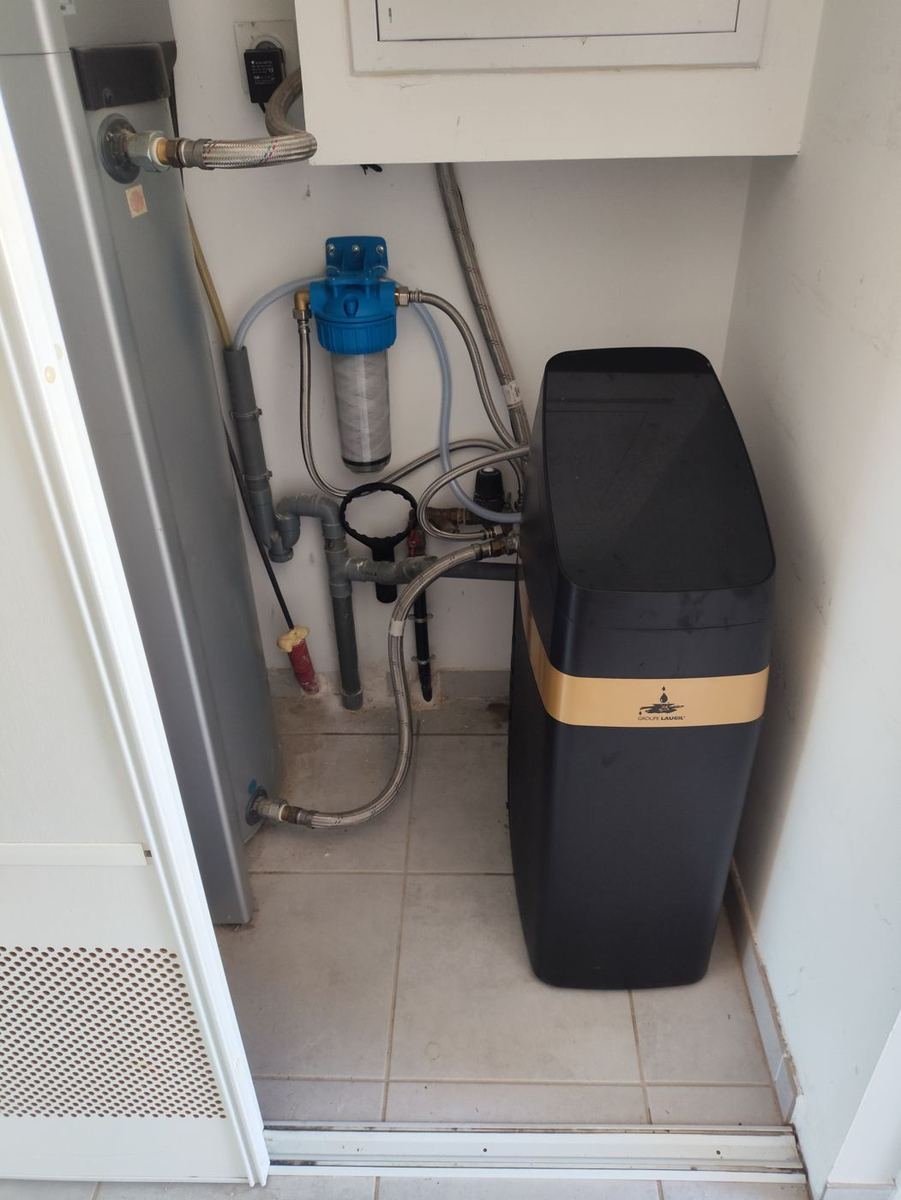
How does a water softener work?
The water passes through a resin that retains calcium and magnesium. When it is saturated, the unit cleans it automatically with brine: this is regeneration.
- It should not remove all the limescale: healthy water should keep some calcium and magnesium. I set the unit to keep a hardness of around 8 to 15 °f. Water that is too soft becomes aggressive for the pipes.
- A setting to check regularly: the hardness of mains water changes through the seasons. Without checks, the water becomes either too soft or hard again. It is one of the points checked at every service.
- The right sizing depends on the measured hardness and the number of people: a unit that is too small regenerates constantly, one that is too big wastes.
A proper installation
- Sediment filter upstream to protect the resin.
- Bypass to isolate the unit (watering, servicing).
- Regeneration wastewater drained with an air gap between the pipe and the sewer: wastewater cannot back up into the unit.
- Commissioning, hardness setting and explanations on site.
What about the other solutions?
- Under-sink reverse osmosis unit: it very finely filters drinking water (nitrates, pesticides, chlorine residues, micropollutants). It only treats the kitchen tap: it does not protect the house from limescale and complements the softener without replacing it.
- Anti-scale filter (polyphosphates): limited protection, useful as a supplement in front of a water heater or boiler.
- Magnetic or electronic “anti-limescale” devices: their effectiveness is disputed. I do not recommend them as the only solution.
Do you need a softener?
| Measured hardness | My advice |
|---|---|
| Less than 15 °f | Not useful in general. |
| 15 to 25 °f | Necessary to protect the water heater, heat pump, taps and appliances. |
| More than 25 °f | Strongly recommended. |
A softener needs follow-up: annual service, in French (resin disinfection, setting check).
Have your water hardness measured
On-site measurement, honest advice, free quote for the installation.